

By Gail Boushey Published: 9/8/2026 Updated: 9/9/2026
There are many ways we can help students grow as readers. One of the simplest is also one of the most important: give them more time to read. Research on reading volume helps us see why those minutes matter.
Anderson, Wilson, and Fielding studied middle-class fifth graders and looked at how much time students spent reading each day. They found a clear relationship. Students who scored in the highest percentiles spent more time reading and encountered far more words each year. Students in the lower percentiles spent considerably less time reading and, as a result, had far less exposure to words and text.
The difference is striking on its own.
Then consider what happens when we add just 10 more minutes of reading each day.
The graphic below combines the reading-volume data from Anderson, Wilson, and Fielding (1988) with a later analysis by Adams (2006) projecting the impact of adding ten minutes of reading time.
Look first at a student in the 90th percentile. At about 21 minutes of reading per day, the original study estimated that student encountered more than 1.8 million words per year. Add 10 minutes of reading each day, and estimated word exposure rises substantially.
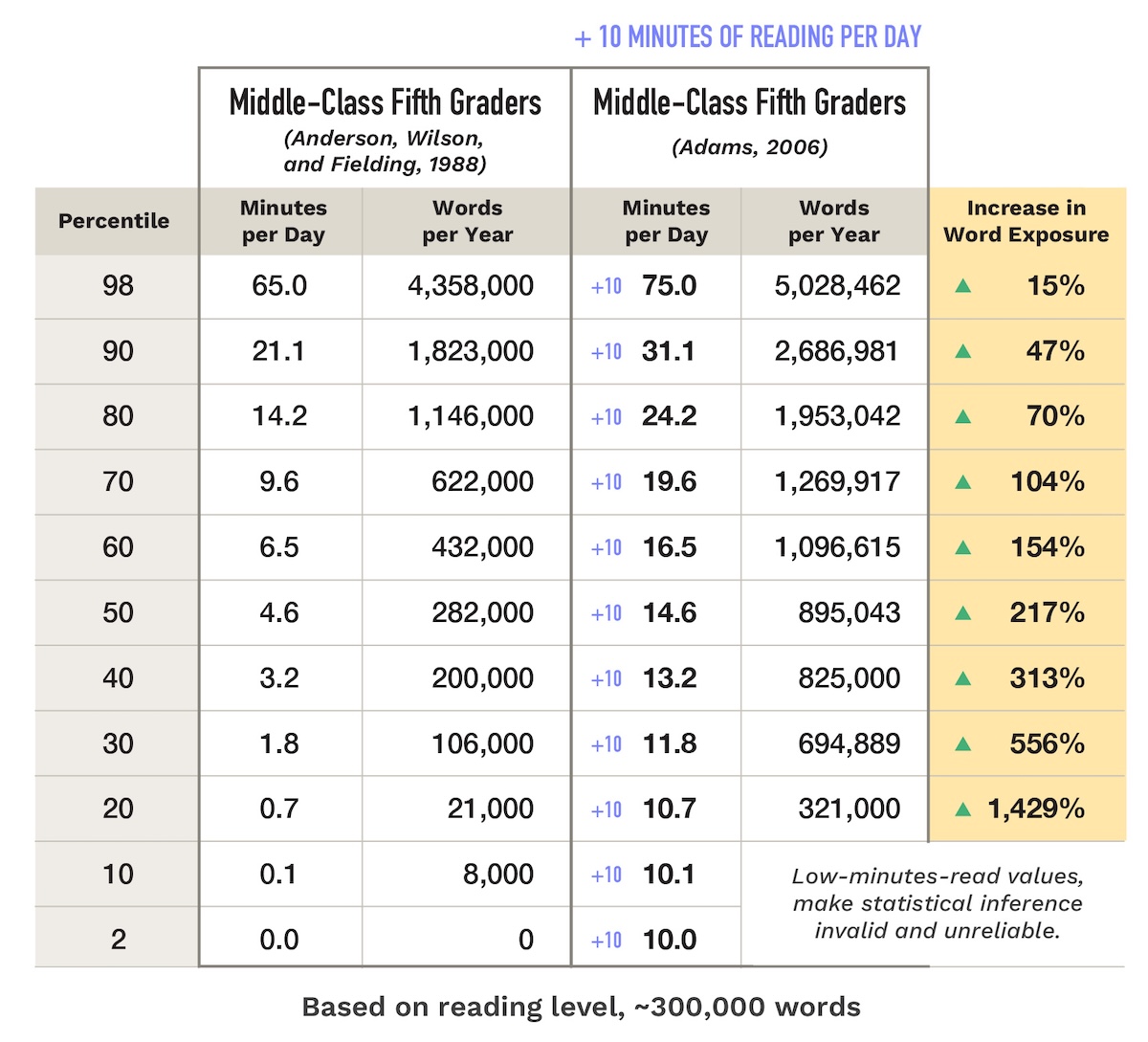
Adapted from Adams (2006), with baseline data from Anderson, Wilson, and Fielding (1988)
Now look farther down the chart.
A student at the 50th percentile averaged just 4.6 minutes of reading per day. Adding 10 minutes more than triples that student's estimated annual word exposure.
At the 20th percentile, the difference is even more dramatic. The original data associated 0.7 minutes of daily reading with about 21,000 words encountered in a year. With 10 additional minutes, the projection rises to approximately 321,000 words.
The takeaway is simple: 10 minutes matters most for the students who are currently reading the least.
More time reading means more encounters with words, sentences, ideas, text structures, vocabulary, and meaning. Those experiences accumulate.
Anderson, Wilson, and Fielding's research also found that, among the ways children spent their time, reading books was the best predictor of several measures of reading achievement.
This helps explain why authentic reading has always been central to Daily 5. We want students receiving strong instruction. We also want them spending meaningful time actually reading. The two work together beautifully.
When we launch Daily 5, Read to Self is the first authentic literacy task we teach students to do independently. There is purpose behind that decision.
We are creating a structure that protects time for reading. Students learn how to choose a workspace, get started, stay engaged, and sustain their attention with a book. As their independence grows, so does the amount of meaningful reading time available to them.
And something important happens for the teacher, too. When students can read independently, teachers gain time to confer with individual students, work responsively with small groups, and provide support based on what readers actually need.
Independent reading becomes productive learning time for students and responsive teaching time for teachers.
Ten minutes can feel small inside a full school day. The chart reminds us how quickly those minutes accumulate. This is also one reason we value brief, focused whole-group lessons within The Teaching Structure. When we are intentional with direct instruction, we create space for students to take what they are learning and use it.
For readers, that means time with books. Daily 5 helps us protect that time by teaching students how to use it successfully. Read to Self gives students a meaningful place to begin, and the 10 Steps for Teaching and Learning Independence help us explicitly teach the behaviors that make sustained independent reading possible.
The outcome is even bigger than adding minutes to a schedule. We are building engaged readers.
Every day students spend meaningful time with books, they have another opportunity to discover what reading can give them. They find authors they love. Topics they want to know more about. Stories they don't want to put down. They begin to develop preferences, confidence, and an identity as a reader.
That is the deeper purpose of protecting independent reading time. We want students to become capable readers, and we want them to become people who choose to read. The ten extra minutes matter because they accumulate into thousands of pages, millions of words, and years of experiences with books.
Ultimately, we are building a reading life that can continue long after students leave our classrooms.
References
Adams, M. J. (2006). The promise of automatic speech recognition for fostering literacy growth in children and adults. In M. C. McKenna, L. D. Labbo, R. D. Kieffer, & D. Reinking (Eds.), International handbook of literacy and technology (Vol. 2, pp. 109–128). Lawrence Erlbaum Associates.
Anderson, R. C., Wilson, P. T., & Fielding, L. G. (1988). Growth in reading and how children spend their time outside of school. Reading Research Quarterly, 23(3), 285–303. https://doi.org/10.2307/748043
Quick lessons you can teach in 10 mins/day so students take responsibility for their learning and rely on you less.
Get the LessonsTeaching is complex. And the challenges teachers are navigating right now are real.
Strong programs, new mandates, and growing expectations have changed what classrooms look like. Yet the foundations of effective teaching remain the same.
Students need to practice independently.
Teachers need time to respond to learners.
Learning needs structure to carry forward.
These are skills that can be built.
At Teach Daily, we focus on the structure of teaching. How lessons, independent practice, and responsive conferring work together across a day so learning lasts.
Choose your next move:
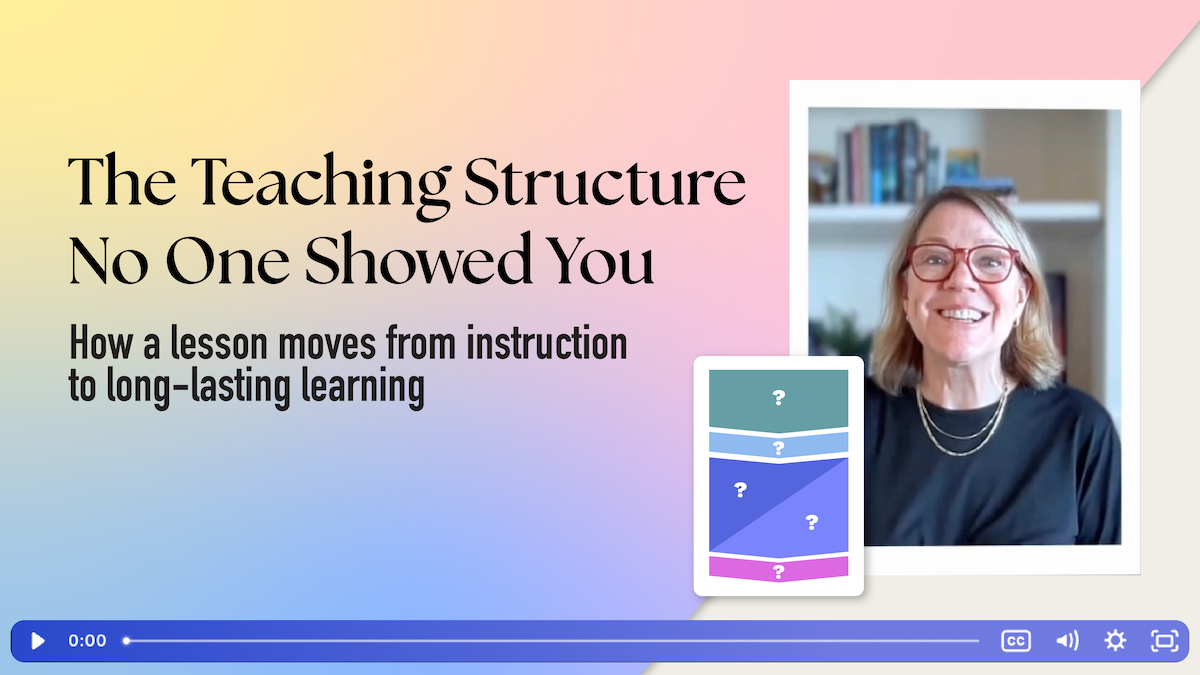
If you want to see the structure clearly, watch this training:
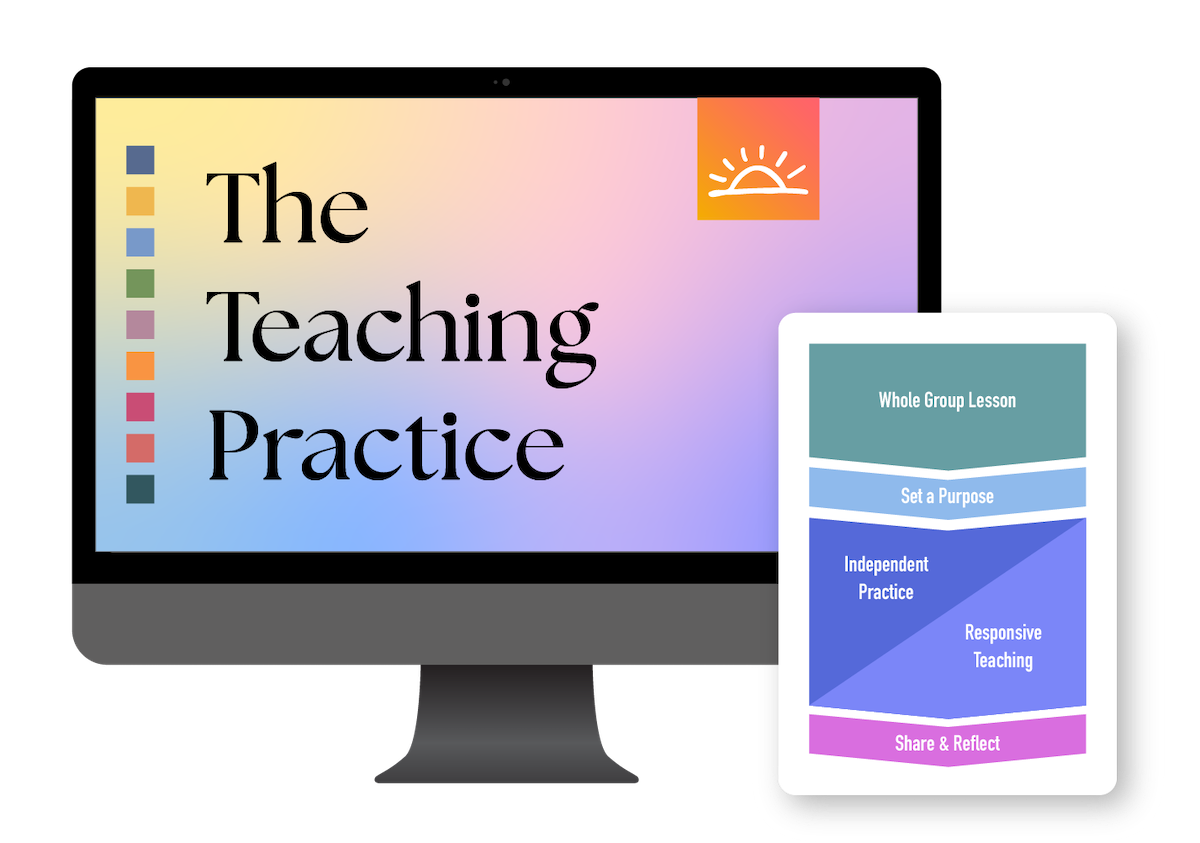
If you’re ready to strengthen these skills:

© 2026 Teach Daily
This site is protected by reCAPTCHA and the Google Privacy Policy and Terms of Service apply.