

By Gail Boushey Published: 10/3/2026 Updated: 10/5/2026
When did intervention come to mean a separate time of day?
In most schools we work with, the day follows a familiar pattern. The core lesson happens during Tier 1. Later, students who need more support go to intervention, sometimes in a different room, sometimes with a different adult. There are good reasons for that structure. Still, it can leave teachers with the sense that helping a struggling reader is something that happens somewhere else, at another time, by someone else.
I have been thinking about the time in between. The core lesson is over, intervention hasn't started yet, and students are trying out what we just taught them on their own. A lot happens in that window, and much of it is Tier 1 work.
Responding Is Part of Tier 1
The National Center on Multi-Tiered System of Supports (n.d.) describes Tier 1 as the core instruction every student receives. Tier 2 has a different job. State frameworks describe it as supplemental, targeted support for learners who need more than Tier 1 provides (Montana Office of Public Instruction, n.d.). It is meant to be added on top of core instruction, never used in place of it. Students in Tier 2 still need a strong Tier 1.
What gets less attention is how much responding Tier 1 is supposed to do on its own. The Institute of Education Sciences practice guide on RTI recommends making time in Tier 1 for differentiated reading instruction for every student, based on assessment of where each reader is right now (Gersten et al., 2009). Florida's Department of Education lists differentiated small group instruction as part of Tier 1 (Florida Department of Education, n.d.).
So conferring, flexible groups, and adjusting our teaching aren't extras. They belong to the core. The IES panel draws a helpful line here: differentiation in Tier 1 is for every student, and Tier 2 is for students at risk in specific areas.
That leaves a practical question for any teacher. When does that responsive teaching actually fit into the literacy block?
What We Learn When Students Try It Alone
Most of us have taught a lesson that seemed to go well. Students answered our questions. They followed along as we modeled. They could do the skill with us right there. Then we sent them off to try it on their own, and some of them couldn't.
Researchers have described this pattern for a long time. Barak Rosenshine studied the habits of highly effective teachers and found that they moved students from guided practice into independent practice, and that students need plenty of successful independent practice before a skill becomes automatic (Rosenshine, 2012). Pearson and Gallagher (1983) called it the gradual release of responsibility. We do the work, then we share it, then we hand it over.
The handoff is where we start to see what students really know. A child who read every word with the phonics pattern during the lesson may skip right past it in a book. A student who could explain how to find the main idea with us may not think to use it when reading alone. Another student may sail through and show us they are ready for something harder.
We can't see any of that while we are doing the work alongside them.
Black and Wiliam (1998) found that classroom assessment raises achievement when teachers use what they learn to change their teaching. Wiliam (2018) has since built on that work, showing how teachers can weave this kind of checking into everyday teaching. Hattie and Timperley (2007) found something similar about feedback: it helps when it shows students where they are, where they're headed, and what comes next. All of this research arrives at a simple idea. Noticing is only the first half. The other half is doing something with what we notice.
Teach. Apply. Observe. Respond. Apply again.
Making Room to Respond
None of this works if the rest of the class needs us every few minutes. To sit beside one reader or pull a small group together, the other students have to be reading and writing on their own, with purpose.
That is the reason we created Daily 5 (Boushey & Moser, 2014). People often describe it by the five literacy tasks, but the tasks were never the whole point. Students learn how to read and write independently so they have real time to practice what their program has taught. The IES practice guide on foundational skills makes the same case, recommending that every student read connected text every day to build accuracy, fluency, and comprehension (Foorman et al., 2016). And that practice time is where we find out what stuck.
While students work, we have time to respond. We confer. We listen to a child read. We jot down what we notice. We give feedback, reteach, or gather a few students who need the same thing. Then we watch again.
Those notes add up. One conference tells us a little. A week of conferences starts to show patterns. Some students need another quick check-in. A handful share the same need and would do well together in a small group. A few are ready to move on (Boushey & Moser, 2009; Boushey & Behne, 2019).
When Students Need More
Sometimes our response in Tier 1 is enough, and the student moves forward.
Other times, the same difficulty keeps showing up. We teach it, the student tries it, we respond, the student tries again, and it still isn't clicking.
This is the situation MTSS was built for. Response to intervention depends on the idea that how a student responds to good instruction tells us something important (Fuchs & Fuchs, 2006). Our notes, observations, student work, assessment data, and screening data start to come together, and they may show that a student needs targeted support in Tier 2 or more intensive support in Tier 3.
When that time comes, we have more than a score to bring to the conversation. We know what the student can do on their own. We know where things break down. We know how the student responded to our teaching. That gives the interventionist, the support team, and the family a much clearer picture of where to start.
Rethinking When Intervention Begins
For years, teachers have asked us what the rest of the class is doing while the teacher confers or meets with a small group. They are practicing what they've learned. And while they practice, we are learning what to teach next.
Teach → Apply → Observe → Respond → Apply Again
Maybe we've been thinking about intervention too narrowly. Tier 2 is extra, targeted instruction, and some students will need it. Responding to learners starts long before that. It starts in Tier 1, every day, when students try out what we've taught and we use what we see to plan what comes next.
Daily 5 gives students time to apply and gives us time to respond.
References
Black, P., & Wiliam, D. (1998). Assessment and classroom learning. Assessment in Education: Principles, Policy & Practice, 5(1), 7–74.
Boushey, G., & Behne, A. (2019). The CAFE book: Engaging all students in daily literacy assessment and instruction (Expanded 2nd ed.). Stenhouse.
Boushey, G., & Moser, J. (2009). The CAFE book: Engaging all students in daily literacy assessment and instruction. Stenhouse.
Boushey, G., & Moser, J. (2014). The Daily 5: Fostering literacy independence in the elementary grades (2nd ed.). Stenhouse.
Center on Multi-Tiered System of Supports. (n.d.). Multi-tiered system of supports within schools: The what and the how. American Institutes for Research. https://mtss4success.org/essential-components
Florida Department of Education. (n.d.). MTSS: Common language/common understanding. https://www.fldoe.org/file/7539/UnderTiers-HO.pdf
Foorman, B., Beyler, N., Borradaile, K., Coyne, M., Denton, C. A., Dimino, J., Furgeson, J., Hayes, L., Henke, J., Justice, L., Keating, B., Lewis, W., Sattar, S., Streke, A., Wagner, R., & Wissel, S. (2016). Foundational skills to support reading for understanding in kindergarten through 3rd grade (NCEE 2016-4008). Institute of Education Sciences, U.S. Department of Education.
Fuchs, D., & Fuchs, L. S. (2006). Introduction to response to intervention: What, why, and how valid is it? Reading Research Quarterly, 41(1), 93–99.
Gersten, R., Compton, D., Connor, C. M., Dimino, J., Santoro, L., Linan-Thompson, S., & Tilly, W. D. (2009). Assisting students struggling with reading: Response to Intervention and multi-tier intervention in the primary grades (NCEE 2009-4045). Institute of Education Sciences, U.S. Department of Education.
Hattie, J., & Timperley, H. (2007). The power of feedback. Review of Educational Research, 77(1), 81–112.
Montana Office of Public Instruction. (n.d.). Montana MTSS essential components. https://opi.mt.gov
Pearson, P. D., & Gallagher, M. C. (1983). The instruction of reading comprehension. Contemporary Educational Psychology, 8(3), 317–344.
Rosenshine, B. (2012). Principles of instruction: Research-based strategies that all teachers should know. American Educator, 36(1), 12–19, 39.
Wiliam, D. (2018). Embedded formative assessment (2nd ed.). Solution Tree.
Quick lessons you can teach in 10 mins/day so students take responsibility for their learning and rely on you less.
Get the LessonsTeaching is complex. And the challenges teachers are navigating right now are real.
Strong programs, new mandates, and growing expectations have changed what classrooms look like. Yet the foundations of effective teaching remain the same.
Students need to practice independently.
Teachers need time to respond to learners.
Learning needs structure to carry forward.
These are skills that can be built.
At Teach Daily, we focus on the structure of teaching. How lessons, independent practice, and responsive conferring work together across a day so learning lasts.
Choose your next move:
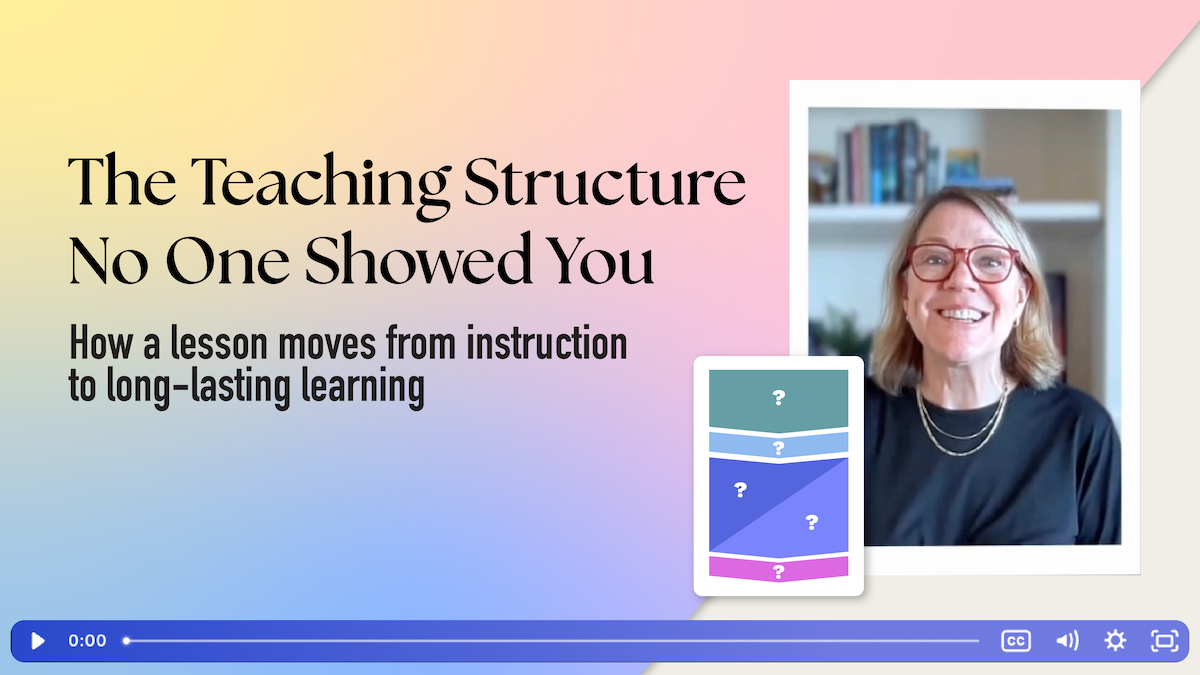
If you want to see the structure clearly, watch this training:
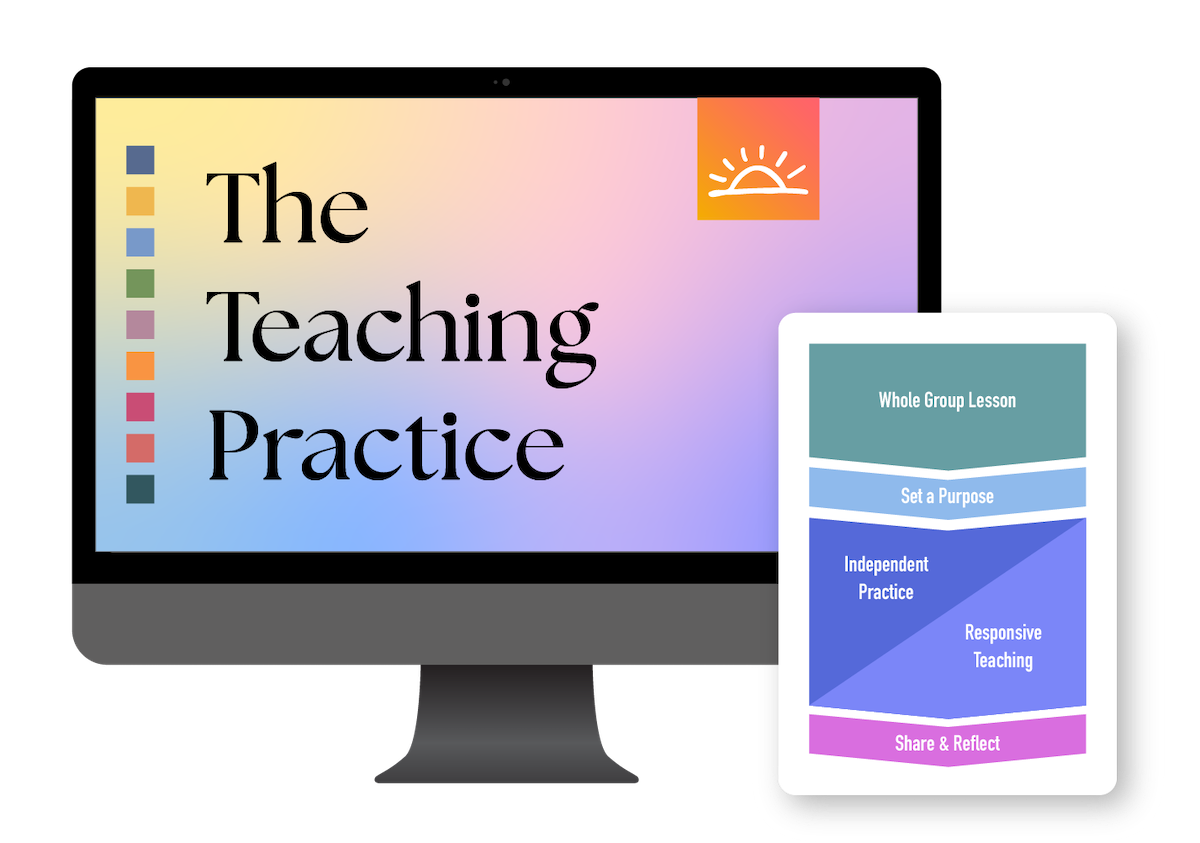
If you’re ready to strengthen these skills:
© 2026 Teach Daily
This site is protected by reCAPTCHA and the Google Privacy Policy and Terms of Service apply.