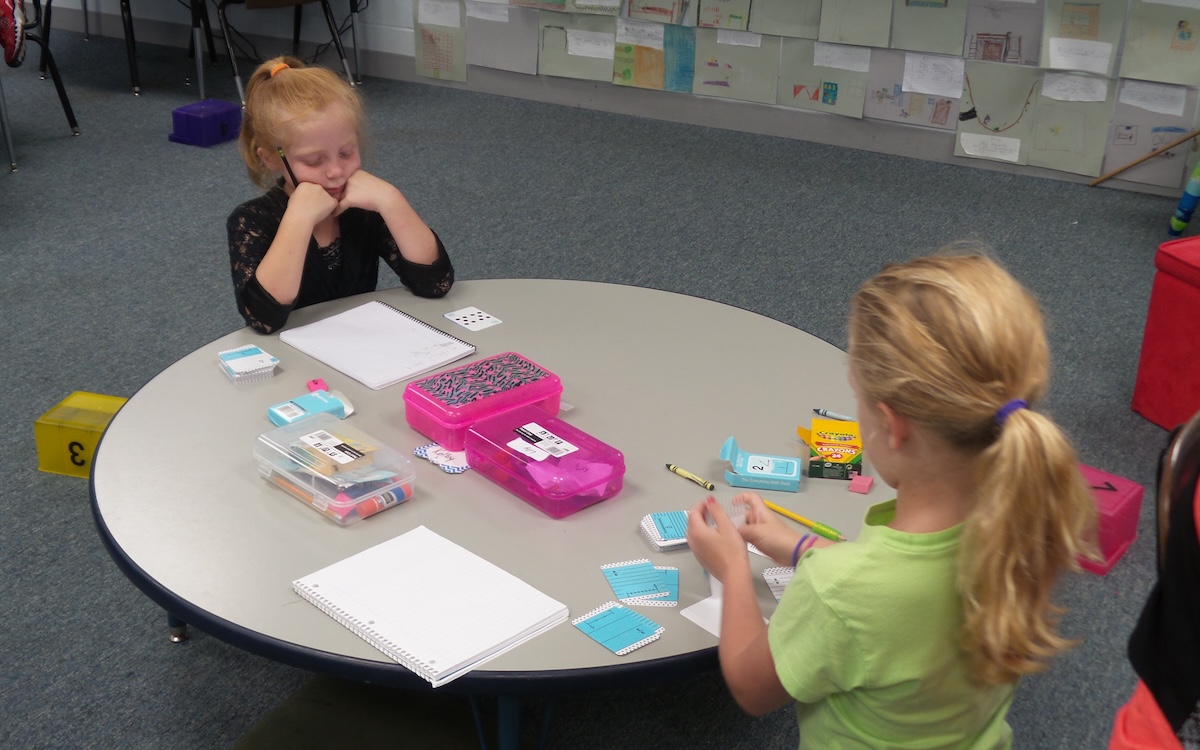
20 Questions gives students an opportunity to practice math concepts independently or with a partner. Students select question cards, solve each problem, and check their work after completing all 20 questions. The activity can be adapted to the math concepts your class is learning.
This activity can be adapted to any math concept you choose.
Materials Needed
- 20 Questions Recording Sheet (copied front-to-back) or 20 index cards (for each student or pair)
- 20 Questions Activity Cards (only one set for the class)
- Pencil
- Answer key
Directions
Setting Up the 20 Questions Activity Cards
- Create 20 questions that cover the math concept of your choice. For example, students might solve problems involving proportional relationships.
- Write one math problem or question on each index card, or use the provided template.
- Once all 20 cards are complete, number the opposite side of each card from 1 to 20. The cards will be placed face down.
- Place the question cards face down in a designated location in the classroom, giving students an opportunity to walk to the cards. For independent use, cards can also be kept in a plastic baggie or hole-punched and placed on a ring.
Playing 20 Questions
- Students select a question from the deck of cards. They may begin anywhere on the recording sheet. For example, a student might start with question 13.
- Students solve the problem or question on the selected card.
- Students return the card to its designated location and select another. If using a baggie or ring, they simply move to another card.
- Students continue solving problems until all 20 questions have been answered.
- Students check their answers using the answer key. Post the answer key in a location where students can reference it easily while others continue working.
For Students Who Need Additional Support
- Provide an alternate set of question cards with simpler problems or questions.
For Students Ready for a Challenge
- Provide an alternate set of question cards with more challenging problems or questions.
Once students know the routine, keep the activity available with new sets of questions. You can change the math concept or level of difficulty while keeping the familiar structure, giving students more opportunities for purposeful, independent practice.
Similar Content by Topic
Downloads
Fillable Blank Game Cards
Example
Answer Sheet for Example