Teachers are constantly making decisions about time.
There’s the lesson itself. The transitions between parts of the day. The independent work students need in order to practice and apply learning. The small-group instruction that helps students move forward.
And somewhere inside all of that, teachers are also expected to collect meaningful information about student progress.
That’s where many classrooms begin to feel stretched.
Progress monitoring matters deeply. It helps us notice growth, respond to students, and make intentional teaching decisions. Yet progress monitoring works best when it lives inside the flow of teaching instead of competing with it.
When progress monitoring becomes part of daily classroom practice, it feels more sustainable and more useful.
Here are five ways teachers can balance progress monitoring with instructional time in a way that supports both learning and teaching.
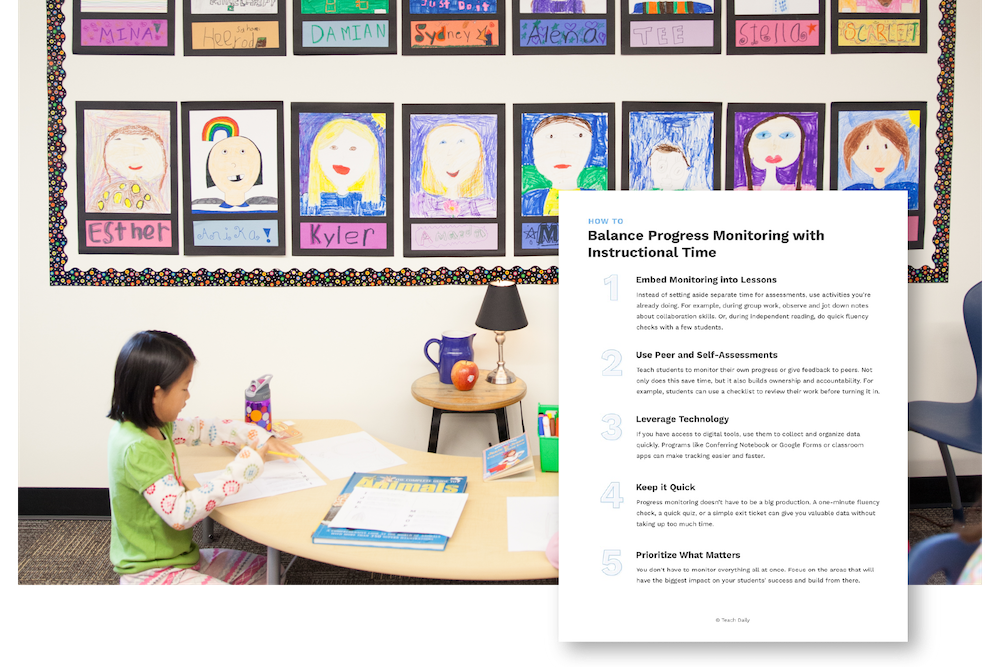
1. Embed Progress Monitoring Into Lessons
Some of the strongest assessment moments happen during the learning itself. Instead of setting aside separate blocks of time for assessments, use the moments that already exist throughout the day.
- During independent reading, listen to a few students read aloud.
- During collaborative work, notice how students explain their thinking or solve problems together.
- During writing, observe how students apply a strategy from the lesson.
These quick observations often tell us more than a formal assessment because they show how students are using learning in real time.
This approach also keeps learning moving forward. Students stay engaged in meaningful work while teachers gather information naturally.
Whole-group instruction introduces learning. Independent practice helps reveal what students can do with it. That’s where progress monitoring becomes especially valuable.
2. Use Peer and Self-Assessment
Students can become active participants in noticing their own growth. When students learn how to reflect on their work, check for understanding, or give thoughtful feedback to a classmate, assessment becomes part of the learning process.
Simple tools help make this possible:
- A checklist
- A reflection prompt
- A quick partner conversation
- A rubric with clear language
These routines help students develop ownership and awareness over time. They also create space for teachers to observe patterns across the classroom while students stay engaged in purposeful work.
Teaching students how to reflect is part of teaching independence. And independence strengthens everything else in the classroom.
3. Leverage Technology Thoughtfully
Technology can help simplify the organization side of progress monitoring. Digital forms, classroom apps, and tools like a Conferring Notebook can make it easier to collect notes, organize observations, and look for patterns over time.
The goal is not to add more systems. The goal is to reduce friction. When information is easy to capture and revisit, teachers can spend less time managing data and more time responding to students.
Even simple systems can make a difference:
- A shared spreadsheet.
- A digital conferring form.
- A quick exit ticket.
The best tools are the ones that fit naturally into the rhythm of teaching.
4. Keep Monitoring Quick and Focused
Progress monitoring does not have to become a large event. Some of the most helpful information comes from short, focused check-ins:
- A one-minute fluency sample
- A quick conference
- A short written response
- An exit slip at the end of the lesson
These moments help teachers notice who is ready to move forward, who may need additional support, and what students are carrying into independent work. Short assessment moments also protect instructional time. Students continue practicing and applying learning while teachers gather meaningful information in manageable ways. Consistency matters more than complexity.
5. Prioritize What Matters Most
Teachers notice hundreds of things throughout the day. Trying to track everything at once quickly becomes overwhelming. Progress monitoring works best when teachers focus on the learning that matters most right now:
- What is the current goal?
- What strategy or skill are students actively practicing?
- What information would most help guide next steps?
When teachers narrow the focus, assessment becomes clearer and more actionable. This also helps students. Clear learning targets make it easier for students to understand what they are working toward and how growth looks over time.
A strong classroom structure supports this process. When students know how learning flows through the day, teachers gain the space to notice, confer, and respond with intention.
Progress Monitoring as Part of the Teaching Structure
Progress monitoring is most sustainable when it becomes part of the natural design of teaching. Teachers do not need separate systems competing for time. They need structures that allow learning, independence, and observation to work together.
When classrooms have clear routines, purposeful independent practice, and responsive teaching structures in place, progress monitoring becomes more manageable:
- Teachers can observe students during authentic learning.
- Students can reflect on their own growth.
- Instruction stays connected to what students actually need.
That’s the deeper purpose of progress monitoring.
It helps teachers see learning more clearly so teaching can remain responsive, intentional, and grounded in what students are ready for next.
And over time, those small moments of noticing become one of the most powerful parts of teaching.